5 reasons good students fail ACCA AAA (and how to fix each one)
 sheila William


Hard-working ACCA AAA students still fail, and it is rarely effort. Sheila William, on the 5 study habits that cost marks, and what to do instead
Every sitting, I meet students who did everything they were told to do. They read every chapter. They watched every video. They filled a folder with neat notes.
And they still failed AAA.
It is rarely a lack of effort. After more than 30 years of teaching audit, I can tell you it is almost always how they studied. AAA is a different animal, and you cannot prepare for it the way you prepared for your earlier papers.
Here are the five patterns I see most often, and what to do about each one.
1. You are studying 75/25 when AAA needs 30/70
Most students spend about 75% of their time on input (reading notes, watching lessons) and 25% on output (writing answers to exam questions).
My split is 30% input, 70% output.
Reading feels productive because it is comfortable. Writing an answer under time pressure is uncomfortable, which is exactly why it is the thing that trains you. Reverse the ratio and, on the day of the exam, your engine will not start.
Do this instead: after 15 minutes of understanding a standard, go straight into a question on it. Then return to the notes to fill the gaps the question exposed.
2. Your notes look beautiful and evaporate by module five
Highlighting. Copying out definitions. Rewriting notes until they look tidy. All of it is shallow processing, and shallow water dries up.
Deep processing means doing something with the standard: connecting it to other standards, asking why it exists, working out what could go wrong in a scenario, and deciding what you actually need to remember.
Do this instead: take one standard and ask yourself three questions. What is this standard trying to protect? Which other standards does it touch? What would I look for in a real client because of it?
3. You answer at level 3 when AAA is examined at level 5
AAA sits at level 5 of Bloom's taxonomy. Level 5 is not "what is it". It is "so what?"
Look at how a full evaluation climbs:
The client is new to the firm. So what? Then the audit team has no cumulative knowledge and experience of this client. So what? Then detection risk is higher. So what? Then I set overall materiality at the lower end of the range and audit more items.
Four lines, each one earning its place. Most answers stop at line one or two, which is exactly where the marks stop.
Do this instead: take your last written answer and, after each sentence, write "so what?" Keep climbing until you land on a risk or a consequence. Then stop.
4. You re-read when you should be retrieving
Re-reading your notes, re-watching a lesson and re-reading a suggested answer all feel like revision. They are not. You either use it or you lose it.
Retrieval means pulling the knowledge out of your own head with nothing in front of you.
Do this instead: take a blank sheet and mind map everything you know about, say, ISA 570, before you look at anything. Then compare it with your notes. The gaps you find are your revision list. Nothing else is.
5. You never count the marks before you write
A requirement is worth 18 marks for risks of material misstatement. How many points will you write?
Most students write as many as they can think of, then run out of time in the next question. I do the arithmetic first. Take out 3 marks for the materiality calculation and its justification, and 2 for the analytics, and 13 are left. Each risk of material misstatement earns about 3 marks, so I am looking for five solid points. Not eight.
Now I know how long each point gets, and I know when to stop.
Do this instead: before you type a word, work out how many points each requirement needs, write that number at the top of your answer, and hold yourself to it. The clock does not care how much you know.
What these five have in common
Not one of them is about knowing more auditing. Every one is about turning what you already know into marks, under time pressure, in three hours.
That is the gap between the students who pass and the students who work just as hard and do not.
Want the full version, free?
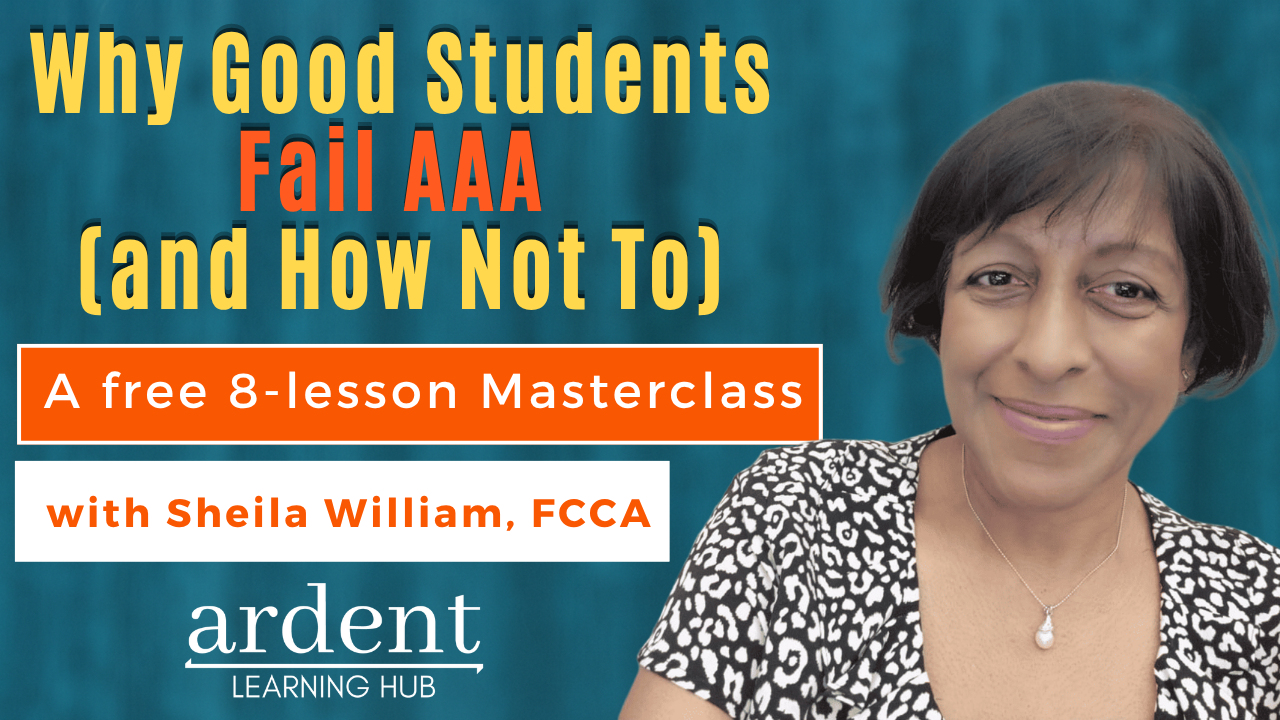
I recorded a free masterclass that takes all of this further: Why Good Students Fail AAA (and How Not To). Eight short lessons, about 80 minutes in total, covering exam strategy, input and output, deep processing, level 5 thinking, growth mindset, retrieval, ISA 320 materiality taken through every step, and how to find study time in a busy working week.
It is free. No card needed. You can watch it at your own pace.
Get free access to the masterclass
Whether you are sitting AAA for the first time or coming back after a disappointing result, I think you will find at least one thing in there that changes how you prepare.
Sheila William, FCCA
Founder and Lead Tutor, Ardent Learning Hub
Free masterclass
Studied hard and still failed AAA?
In 8 short video lessons, Sheila William FCCA shows you how to study the way the AAA exam is actually marked. It's free, and you can watch at your own pace.
Watch the free masterclass → Not sure which course fits? Take the 2-minute course finder